
Can Rheumatoid Arthritis Affect the Spine?

You can’t get Rheumatoid Arthritis in the spine, can you?
(The funny noises in my neck say yes. Let’s see what the funny-sounding medical words say about RA in the spine…)
The only books on Rheumatoid Arthritis that I read are ones from “legitimate” sources such as recognized university hospitals or M.D.’s who specialize in rheumatology. But, there has been a problem: the experts often disagree.
A chief area of disagreement is which joints that can be affected by Rheumatoid Arthritis. Most authors include their list. However, the different lists do not match one another or the facts that I have learned firsthand.
Rheumatoid Arthritis in the spine is one prominent example. I have read several lists which exclude the spine. I have also talked to doctors who believe that the spine cannot be affected by Rheumatoid Arthritis.
I am only reporting the RA spine facts as I read them
Well, I don’t imagine that I am equipped to argue with experts. All that I can do is report the facts as I learn them. Here are some facts about Rheumatoid Arthritis in the spine.
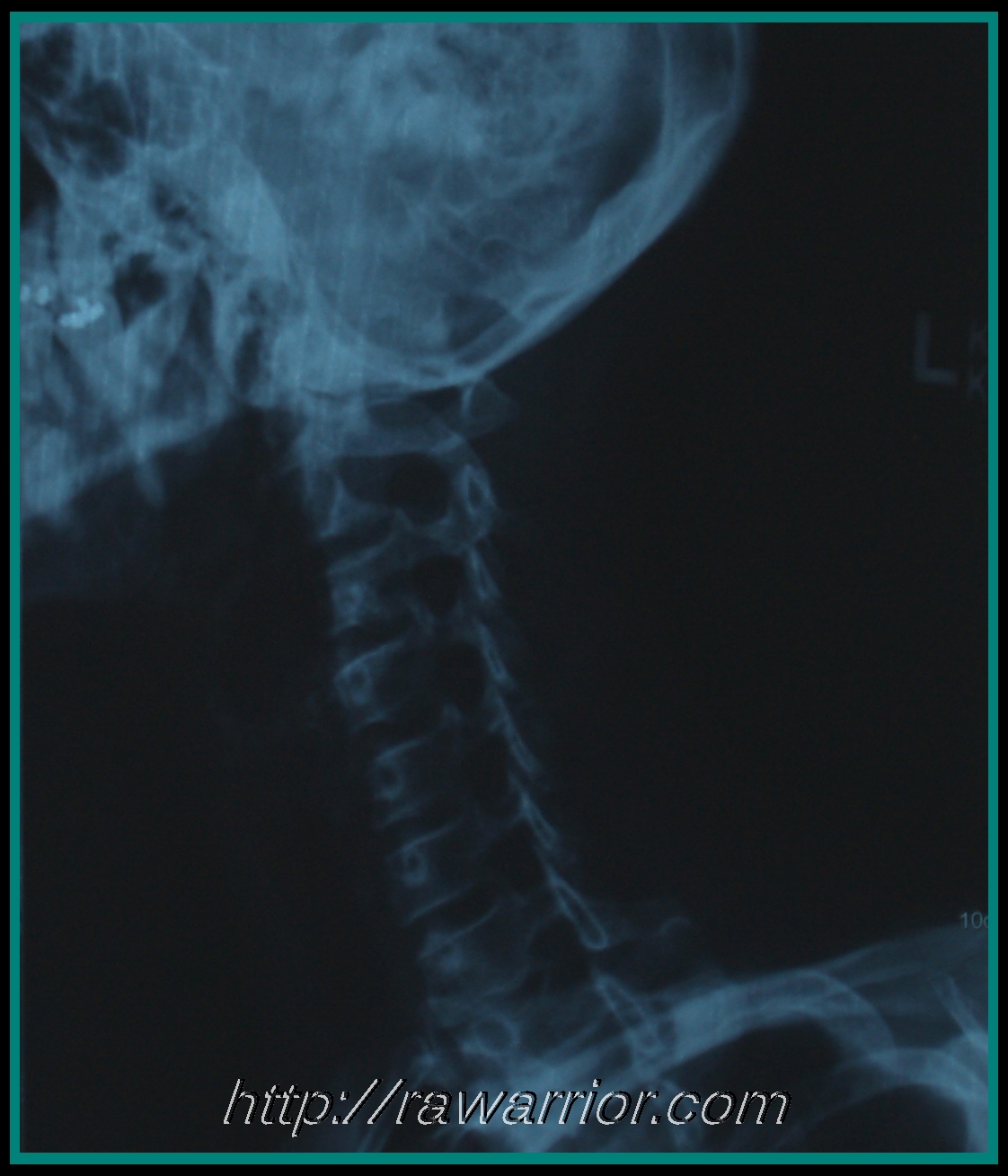
The doctors who write a site called Spine Universe describe in detail the manner in which RA affects spinal joints. They say that the neck is usually the first area of the spine to be attacked by RA. An excellent illustration accompanies their clear description of Rheumatoid Arthritis in the cervical spine.
Let me quote to you a report from WebMD’s emedicine since I cannot say it any more clearly myself:
“RA activity in the cervical spine begins early, with 83% of patients in prospective studies developing anterior atlantoaxial subluxation within 2 years of disease onset. Activity in the cervical spine progresses clinically and radiologically in tandem with the peripheral-joint involvement. In fact, the severity of the peripheral erosive damage is strongly correlated with the degree of structural damage in the cervical spine.”
83% of people with RA have involvement in the atlantoaxial joint within 2 years. The atlantoaxial joint is between the first and second vertebrae in the neck: C-1 and C-2. That is the joint which caused the predicament of Nicole Bradshaw that I reported here last week.
Joints in the spine affected by Rheumatoid Arthritis become unstable. Damage to supporting tissues can cause vertebrae to slip in a process called spondolisthesis. The result can be pain due to pressure on nerves caused by the slipped vertebra. The spinal cord can be compressed which can cause a wide range of symptoms.
Although it is more common in the cervical spine, the thoracic and lumbar spine can also be affected by Rheumatoid Arthritis. It is not too difficult to find examples of this in medical journals. After one study, the Journal of Bone and Joint Surgery stated, “We submit that subcervical rheumatoid spondylitis is commoner than is generally believed, though less common than rheumatoid involvement of the cervical spine.”
Question: Why can I find this information with just a few hours of research when some M.D.’s are confused about it? Is it because I have no prejudice against the existence of Rheumatoid Arthritis in the spine? Thank God for RA in my spine, I guess, which enables me to shine the light on the truth.
Check out this essential little book about RA and the spine: Death by Rheumatoid Arthritis: Possible and Preventable
Read more about how RA affects the spine!
Recommended reading:
- Nicole Bradshaw’s story: Rheumatoid Arthritis and Basilar Invagination
- Ridiculous reactions to RA: So Glad Your Rheumatoid Arthritis Is Cured
- Good news happens: The Truth About Rheumatoid Arthritis Will Be Told!
Edited: Mar 22, 2017, to update a link that had changed.


Pingback: Can Rheumatoid Arthritis Affect the Spine? | rheumatoid arthritis information
It seems contradictory to me that doctors describe RA as a systemic autoimmune disease that can cause damage to everything from your toes to your lungs and your heart, but exclude the neck and spine… How much sense does that make?
I describe pain and noises in my neck and shoulders, which my rheumy doc ignores while he examines at my fingers (minimally affected so far) like they are the absolute essence of RA activity.
It is hard enough to fight my own denial and fear of what RA can do to my body. Then to have rheumy docs who ignore what I am reporting while they focus instead on blood test numbers and a very narrow perspective of a one-size-fits-all quick exam.
God bless you, Kelly, for bringing the RA Warrior blogsite to us!
It is so refreshing to have the validation that, yes, my symptoms are real, and that yes, they DO matter. You are helping me to become a more informed self-advocate when I go for those quick-exam rheumy doc visits.
Thank you,
Caysea
Caysea,
Well said.
I do not know what motivates such dr.s either.
I have read some incredible spine stories – it is definitely real.
Thanks so much for bringing this information to us Kelly. In my case, I was told many years ago by my ortho, rheumy and anesthesiologist about the danger of RA in the cervical spine.And it was something that they always checked. The anesthesiologist mentioned that all RA patients should have a c-spine x-ray before any surgery where they are going to have general anesthesia. They need to check the amount of degeneration and stability of the c-spine due to RA. He told both me and my husband that if the RA was severe in the c-spine there could be serious complications during intubation while under general anesthesia. Because of that I make sure that before every surgery I have an updated c-spine x-ray for my surgeon and anesthesiologist
Jacque,
Thank you for this good advice. I’ll try to pass this on to others. I am so thankful that your doctor was so informed. (I have heard horror stories about doctors who tell patients that “you can’t get RA” in the spine.)
Wow, Jacque thanks for that! its good to know!!
Thanks for letting me know that the RA in my neck and lower facet joints weren’t just trying to make my Rheumy look stupid they had something to say! I believe they were saying “Hey Doc, we got RA no matter what you say!”. My pain management Doc says RA or OA, I have both, who cares IT’S ARTHRITIS! He’s not a fan of my Rheumy…LOL. My neurologist says she doesn’t know why I have nueropathy in my hands and feet I’m probably just depressed, I look depressed to her so she gives me the name of a shrink! 2 years on pred. I have cataracts, I’m 49 w/cataracts, no more pred for me EVER!!!!!! I may need a new Rheumy he’s only had x-rays done once in 3yrs.! Maybe if he did a full body he’d find the RA in my spine…What do you think…
Funny, Alice 😕
Neuropathy is not uncommon. I am only guessing, but it makes sense that swelling inside of joints, especially the spine, would lead to compressed nerves. Maybe this is the cause of “burning” sensations also. I’m not sure.
I have heard the shrink comment numerous times. And,sorry about the pred. I also went a few years w/no x-rays ordered. Sometimes that’s good because x-rays are not sensitive enough to find anything until it’s bad.
Haha. Did you read this post about finding a new rheumy? :chic:
thank you warrior, you’ve again come forth with some great information,, i have terrible back problems,, i know they come mainly from the work i did ( roofing) , no doubt about that,,,but,,,,, since i was diagnosed with R A it seems it’s gotten much worse,, no doctor has said my spine is affected by the R A,,,,but i wonder ????????
Thanks for your blog. My Rheumy just sent me for a MRI on my neck after my last exam and what did it show? Severe narrowing of the spinal cord where the nerves that go to the upper extremities. Also another area where there is pressure and narrowing of the spinal cord. I have been on pred in high doses since the fall of 07 and would love to get off of it. Also doing methotrexate, humira and lodine and some days it seems like I am on nothing. Now I am going to see a neurologist about the MRI results. I am thankful that I found your blog. Some days I feel like I am the only one going through this pain and that it is all in my head.
Sorry about your neck, but glad you have an idea what’s going on. You are definitely not the only one going through this pain. I like to say: “No, it’s not in my head; it’s everywhere else.”
I want to thank you so very much. I have ankylosing spondylitis. It is arthritis in the hips, spine, neck,shoulders, i’m sure you get the picture. When i read your blogs it feels like you have crawled into my brain and were typing as you saw it in my thoughts. i feel normal in my diseases now. you are so right when you say everything is s different now. i am humiliated at least once a month and left with an empty feeling when my rhumy tells me well i can’t recommend you for enbrul anymore and you juct call me as needed. she has never done anything but put me in a study and then when my pain wasn’t good enough for her she drops me and leaves me hanging. i have been told i am just depressed. i feel like tell him “DO YOU WANT TO SEE DEPRESSED? anyhow thank you so very much!!!!
Hi Steffie Jo,
There’s only one post on this site specifically about AS, but we have several readers who have AS. It does seem like we have a lot in common. I too feel better when I read someone’s experience that sounds like me. It helps.
What on earth about the Enbrel? It was a VERY hard thing to find a new dr, but I’m glad did. Why do we have to fight with the dr that our pain is real? What makes a dr think it’s not bad enough? This is one of the things that keeps me working on this site. We need to fix this.
Thanks again Kelly – I appreciate all your efforts and insight! I ‘fixed’ or at least addressed some of the feet problems and it seems things have moved to the back. Sitting most of the day at a computer does not help! I am going to get the first set of back x-rays since I have been diagnosed. It will either put my mind at ease or at least give me a ‘signature in time’ of what the spine does look like today. I’m trying my hardest to find the more natural methods to help manage the pain but really wish I had something on hand for the days the pain is severe just to be able to function with some level of comfort. They just don’t seem to want to dispense/experiment with pain meds and the last thing I want right now is to add a pain doc on top of it all. It is NO FUN being in pain – so I laugh a lot!!!
Hi Jamie, Many things do not show up on x-rays. Of course, MRI’s show more. What kind of “natural methods” deal with this kind of chronic pain in the back? Heat and rest?
THANK YOU SO MUCH! I wake up every morning with stiffness in my back (all over), that doesn’t go away until the rest of my RA pain/stiffness does. I’m told that I have osteoarthritis in my back b/c RA cannot be there. Well, I may have OA ALSO, but I know what RA pain feels like, and ITS IN MY BACK FOR GOD’S SAKE. I can’t tell you how relieving it is to see someone who gets it! I can’t stand up straight every day, and it just coincidentally goes away when the rest of my stiffness does (if it does that day).
Last part was sarcasm there lol.
oh yeah, I got that. 😉
I have RA in my Cervical spine! I have had two disk fusions 4-5 & 6, and just went for another MRI due to problems I am having again in my neck.
I learned I had RA after my first disk fusion. It is very painful and uncomfortable. I can’t see how they can exclude any joint from RA…
I caused damage in my neck in a motorcycle wreck, 2 actually, so I think that is why RA settled there first. I have also had two hip replacements due to RA. I hate this disease!!!
Yes, Cathy. I don’t know why the confusion. I still not only read articles that say “no RA in ______ joints” – I also have some people comment on the blog telling me I’m wrong. Cervical spine RA is quite real for the majority though, unfortunately.
How many years before you had the hip replacements? I’m starting to get nervous. I haven’t had any replacements yet.
I have had neck pain for years. My fingers also are very arthritic. For years my MD suspected RA, but my panels always came back normal. He then did a newer blood test (I cannot remember the name) – normal was 20 — I was > 97. My neck is my main source of pain. I have a very difficult sleepin due to this. Also I have very limited ROM of my neck. My rheumatologist said I have cervical stenosis. What are the further symptoms of RA in the spine. Am I misdiagnosed regarding my neck?
Hi Diane, of course I can’t see your neck & I’m not a doc anyway. But I can guess that your test was the anti-CCP test. Here’s a link to more about those tests – click here. The neck is affected in a large percentage of RA patients as you read here. Even if it is classified as stenosis or something, it is my understanding that it could be caused by the RA. RA in the spine could lead to a variety of different conditions. It is the same with other joints – one patient could have syntovitis in a joint while others have bursitis or others have erosions or nodules… the cause of any of them would still be the RA. Does that help a little?
I was diagnosed with RA yesterday & am doing a lot of research today. I find it interesting too that in all the research, nothing about the spine came up. I was on a website where you could pinpoint your aching joints, but the spine was not included. Most of my pain is in my spine. In fact, that cervical area has been hot for months. To find your post, I had to search for RA in the spine. — Now I’m off to look at Spine Universe.
Best of luck to you with your treatment Anne-Marie! Were you diagnosed quickly?
Thank you so much for this site. I have learned info and tips that I would not have found on my own, and of course, even the best rheumy cannot keep in touch with patients several times a week. Reading about other people who have the same problems, in this case from the top of the spine all the way down to the bottom, helps me to feel not so alone and to appreciate even more my husband and a few friends and family members and a rheumy and doc who really do get it. Voltaren Gel usually gives some temp. relief for my back pain, as does a lightweight girdle for lower back pain. Different things seem to set off pain in my upper back. Washing too many dishes, preparing too many potatoes, etc. causes an unbelievabe cramp that goes all the way down my arm. It is the kind of pain that makes a person feel like she is going to throw up. People at church seem to think that I am lazy because I can’t wash countless pumpkins to get them ready for the annual patch. I don’t plan to go to church in Oct. just so that I won’t get hassled every Sunday about helping in the patch. I am just sick of it. My cousin who is almost thirty years younger than I am (I am almost 69) has brought it up countless times that she could sure use my help defrosting her freezer, painting her house, etc. I am sick of that, too, and don’t spend as much time with her as she would like as a result. RA sure can lead to a lot of isolation. It is so frustrating and so demeaning to be treated that way. Although my whole spine is always sore, it hurts worse at night. There are times when I literally cannot stand up straight when I first get out of bed, but that gets better as the rest of the RA gets better. I thought it was all osteo and stenosis, but maybe not. My last x-ray did show quite a bit of osteo in my lower back, but apparently that doesn’t mean RA isn’t playing a part, too. Unbelievable that a doc would take a patient off embrel because she wasn’t in enough pain. I was told that when RA meds work for a patient, they are supposed to help with pain. Sorry this is so long and rambling and I am so grippy. After dealing with church on Sunday ( we were asked which week we could come up to the church every day and turn all the pumpkins in the patch, most of which are too heavy for me to even lift and dry them off if it rains) and my cousin asking me for the umpteenth time yesterday about help in painting her house, and finally realizing that our dreams of driving for hours and hours like we used to to get to a destination are never going to happen because now is as good as it is going to get, and it is only Tuesday morning. lol
What an irony with your cousin, Charlene! Wow.
Do you mean your RA doc took away Enbrel because you still had pain? I hardly know anyone with RA who is without pain.
Kelly, I just read your article about RA and the spine. Before being diagnosed with RA, I spent about 3 years with horrible back problems. I finally found a wonderful pain management Dr. I too, have facet arthritis, which can cause some narrowing of the spine. I did a lot of shots, which helped for a while. I then had the radio frequency done and that helped for almost a year. It really all depends on if they get the right facet. I haven’t had a shot in my back for a year now… I do go to a good chiropractor that does acupuncture on me and it does give me some relief. But I do it every month. All in all I think it is trusting the docs. just like with RA, finding the right doctor for you… In my heart I feel like back problems and RA can be related.
The other day I came home from work and told my husband about getting up from the desk chair, being bent over until I got to the fiction section( I have worked in the library for 25 years) before I was standing straight up. I was making fun of myself. He asked me how I could laugh about it and how angry(a little more graphic than angry) he would be if it was happening to him. I tried to explain that if I didn’t make light of all the changes in my body, I could be depressed and never want to get out of bed…. I still don’t think he understands RA….. Hope you are doing the best you can today, we all love you for giving us a sounding and information board, Kelly.
Warmly, Stephanie
You know, I should be used to the things you write about sounding familiar, but I guess I’ll just let myself contniue to be surprised. I have not sensation on my neck. I take a HOT shower and don’t realize how hot the water is until it touches my arms or legs as it runs down my back. I feel the water hitting my neck, but no temperature is felt. It is also the same with my lower back.
I hear my neck “grinding” whenever I look from side to side, and it used to “pop” or “readjust” when I turned, but now I think about it, I haven’t had that problem in 3 months (methotrexate maybe helping?).
One other thing I’ve noticed has been progressively getting worse with my neck, is the fact sometimes I just _can’t_ hold my head up. That it takes EVERY ounce of energy to keep it in place. Which I understand is more muscular than joint related.
Thank for the info.
Have you seen a spine specialist or a neurologist? That does not sound good. Even if the reason you have it is RA-related, it may often take a different specialist to deal with it. Good luck to you, Katie.
After reading one of the comments, about damaged vertibrae in the neck possibly increasing RA settling in there (being they are weaker, kind of makes sense), what would stop RA from settling in to my lumbar, where the coxic is broken and fused back wrong? (Please excuse my spelling mistakes.)
I know from reading rheumatology books in the hospital library that the cervical spine can be effected. That the danger in this joint being effected is that it can cause paralysis. It is strange (or maybe not) that so many of you are not assessed for this joint being effected. I suppose since it can be so alarming of a problem, the whole don’t freak out the alarmist patients quandry that our favorite doctors face. I really think that the nature of our disease causes doctors to follow a algorithm of treatment path and if we vary that path, all pandemonium breaks loose. We become difficult patients. My c-spine has crepitus all ofthe time and gets stiff, but would dare tell my doctor, he’s doing all that he can (NSAIDS, DMARD, pain meds, biologics). What else can he do (I can see him saying it).
Beth, cervical spine involvement is the norm. About 87% of patients have it w/in 2 years. I’ve found a lot of ignorance about this in the rheum community. If you have any concerns about the spine, it might be best taken to a spine specialist. Also, I’ve found that other specialists are less likely to tell RA patients that their symptoms are meaningless because they are not “fatigued” of hearing about them. Does that make sense? That “what else can we do?” thing you mention is nuts. It’s less likely to happen with another specialist – there is plenty to do usually. It’s a matter of timing – is it time to block pain or fuse or whatever…?
I didn’t mean that you are “nuts” – I’m just tired of rheum docs not addressing the spine issues.
I totally agree that rheumy’s get “fatigued” in hearing our symptoms, our troubles. It only shows what a difficult disease this is and it takes special people to look out for us. I keep thinking about the previous generations that got the valium prescription and hysterics diagnosis. I’m “fatigued” with my rheumy!
Oh that’s funny. :O
http://www.ncbi.nlm.nih.gov/pubmed/21091389
Lumbar radiculopathy caused by foraminal stenosis in rheumatoid arthritis
I am 81 years old ( young) and have just been diagnosed with R. A. I was already very familiar with it as my Husband developed it at age 49 and was diagnosed with classical RA-living for 12 years afterward, but being on Methotrexate the full time as no other drug worked with his RA. At the time he began treatment, methotrexate was still experimental in RA treatment. To my knowledge there is no history of the disease in anyone in my family background. I have read that it can be contageous and also geneticly possible. I am hoping mine will be a mild case. It began in one knuckle, and at the time I was being treated by an orthopedic doctor who was treating me for a torn rotator cuff injury and he diagnosed it as gout. Soon afterwards the other hand presented with the same knuckle swollen, and my family doctor said R.A. I had that confirmed by a rheumatologist yesterday after X-rays and blood tests were done. I am now starting the drug sulfasalazine 500.mg 2 times daily, and am optomistic that it will help. I have had several heart attacks, have had 5 bypasses, atrial fibrilation, diabetes, back surgery, and knee surgery. I wonder if I had a silent RA that contributed to those, as well.
Carolyn P.
I am 55 years old I have had RA since I was 30 very serve. Since I started Enbrel shots I went from a wheelchair and walker to moving around, dancing, I even walked my fist 1 mile walk for Arthritis. I am living proof that this can happen…. The doctor said that my neck fused after I wore my neck brace for 7 months. Now I have to have neck flexion x-rays once a year, to make sure it is still fused. I guess God has been looking over me. He must have a reason why I am moving around and doing what I am doing. People say I inspire them. I want to say thank you, but y’all inspire me !
I have had arthritis of the spine since I was 26 years old. One doctor told me he had never seen a young person with so much arthritis of the spine ( after a painful flare-up). I was not diagnosed with RA until I was 62 after years of painful joints and fatique. The doctor who diagnosed me , a very kind man and a rheumatologist, with ankloysing spondolysis died. The new doctor who inherited me now tells me thats impossible. I went home ande cried.
Hi Constance,
I just saw this abstract:
Clin Rheumatol. 2011 Apr 20. [Epub ahead of print]
Coexistence of ankylosing spondylitis and rheumatoid arthritis in a female patient.
Baksay B, Dér A, Szekanecz Z, Szántó S, Kovács A.
SourceDepartment of Rheumatology, Hospital of Hungarian State Railways, Verseghy str. 6-8, 5000, Szolnok, Hungary, b.baksay@medrom2003.hu.
Abstract
Ankylosing spondylitis (AS) and rheumatoid arthritis (RA) are two distinguished representatives of inflammatory rheumatic diseases. The two diseases differ significantly in their etiology, pathology, clinical signs, and in the nature of articular manifestations. Their association has been a rarity in the literature. Here, authors describe a case of a 55-year-old female patient with AS associated with RA. Her spinal symptoms started in 1979, and the diagnosis of AS was established based on the typical clinical picture and X-ray. She developed severe spinal deformity during the next decades. In 2005, peripheral polyarthritis developed, although neither the diagnosis nor the treatment was modified. In 2007, authors diagnosed seropositive RA. Therapy included anti-inflammatory therapy and traditional disease-modifying agents, eventually followed by biological therapy.
PMID:21505766[PubMed – as supplied by publisher]
I just had major surgery on my neck 3 weeks ago. My orthopedic surgeon said the “something” has obviously destroyed my neck. I’ve had RA since I was a teenager. I am 45 now. I have also had two back surgeries. I know of another person with RA who has had 3 back surgeries and 1 neck surgery. I can honestly say that I am not convinced that RA DOESN’T affect the spine. I really think that the “experts” need to research this more.
Thank you for a very good article that brings attention to a neglected subject.
I too had horrible pain start in my neck (it was fractured when I was a teen) and spread from there. I have RA in all my joints, eyes – even my ribs hurt.
The doctor says I don’t have it in my neck or back, even though xrays show damage. My neck now makes crunching noises every time I move it.
It only lessened with the combination of RA drugs and even then It keeps me up at night, just not all the time.
I would like to see more open-minded doctors, instead of a quick dismissal of the “symptoms” as some seem to do, as described by many here.
I am 82 years old and was diagnosed with RA about 6 months ago. I had back surgery for a ruptured disk while in my thirties and retired several years later due to disk problems in my neck because at that time neck surgery was pretty primitive and I was pesimistic about it helping. Is it at all possible that these earlier problems could have been due to having RA during the earlier years before being finally diagnosed with it more recently?
In Feb. 2011, I had double lumbar fusion, and was told my “neck is a mess” but not ready for surgery yet…oh, good…I also have other spine problems. I was told RA didn’t CAUSE my problems, but it “accelerated”them, what ever that means. At least I had a very good surgeon, and I’m doing better than expected. Funny thing, the Dr. said that this what he has learned to expect from his RA patients…they know how to live and work through pain, so they aren’t deterred by it. Guess that’s one “good” thing about living with RA…
I have had rheumatoid arhtritis for 31 years and have started having neck pain and crunching sounds in my neck. My xrays 6 months ago showed degeneration in the c3 and c4. I now started having numbness and tingling from my neck down my arms when I lay down in bed at night. I saw my rheumatologist who is now setting me up for an MRI of my spine. Has anyone else been experiencing this and what was done to help this problem? Any suggestions would be helpful.
Dear Lorna, this is common and I do hear it from patients all the time. I am glad you hear that you have docs who are taking this seriously. I hope they keep an eye on your neck & spine & continue to listen to your symptoms! If damage is severe enough to make the spine unstable or to impinge on the spinal cord, then surgery can be done to fuse joints and stabilize them. But there are other things done before that point, so hopefully that won’t be needed any time soon. Sometimes, just a brace can be used while the neck joints are inflamed or there are various types of injections to arrest inflammation or block pain. If you need to make decisions about what to do, you might need to see a good neurosurgeon to ask how you know when surgery is the option for you. Hope that helps some.
Thankyou so much Kelly for your quick response and all you do for all of us that are dealing with this terrible disease.
I’ve had RA for 17 years now, I take Methotrexate and Prednisolone, I had an MRI which showed Spinal Stenosis, which apparently is caused by arthritis in the spine, my Rheumatoligist says I don’t have it in the spine, even though I have on going neck and head pain, I’m confused to say the least.
Thank you so much for this website, and today, specifically for the spine information. It is so helpful to me, as I am trying to get info for my sister, who has multiple health problems, and (with not much assistance and NO collaboration among the doctors)are trying Her Rheumatologist and Anesthesiologist (pain doctor) seem to have different viewpoints. We are trying to sort out which symptoms come from which medical problem. Because there was conflicting info on the web, I thought I had not found the right answer. Thank you for clearing up that there is no consensus.
I get very worried about my sister. We are not sure which rheumatologist or pain doctor will be helpful and she has had bad experiences.
Is anyone aware of a rheumatologist or pain doctor in the Rhode Island vicinity that they can recommend?
Thanks!!!!
(Sister) Jan
Hi Jan, It might be helpful to read through the other spine-related articles here (https://www.rawarrior.com/tag/rheumatoid-arthritis-spine/) and check out the articles linked to. It is so important that your sister get the right treatment for her spine. The spine is affected in most RA patients and it can be serious, but there are things that can be done to preserve her health. I hope she finds the doctor who can answer her questions and provide needed help very soon.
I just recently got diagnosed with RA. It started in my shoulder then both hands numb ect. Neurologist sent for mri, doctor said i have cervical spine disk disease and that was the pain that I had in my shoulder. Now I’m being referred to a neuroseurgen because I have shooting pain in my hip and leg and cant walk.
So do I think you can have RA in the spine???? YES!!!
Thank you for putting all of this information together. I was so happy to have found your website. I have been recently diagnosed with RA…I’m 27, I’m not overweight and I was running 36 miles a week before having my most recent baby who is 5 months old. It certainly affects the spine. After my first baby I had consistent pain in my back and I thought it was from the Epidural. Come to find out it was one of the earlier signs of RA. I am just starting out in the RA so I have no idea how to live with this. I have always been very health conscious and against taking marketed drugs but I cannot get through the day without taking 2 extra strength IBuprofen. I have it in both wrists, both knees, both ankles and my back if I lay on something stiff. I have started to have a hard time lifting my baby because of my wrists and getting up from a sitting position is very painful because of my knees. I wake up in excruciating pain unless I time my Ibuprofen just right before bed. I feel like I’m 90 basically and it makes me want to cry only being 27. I worry about taking IBuprofen every day because it’s linked to Breast and Kidney Cancer but I do not know of anything that is SAFE to take or to ask for. I thought of maybe getting on Birth control because I read that that can help. I am much newer to this than most of you so if any of you have any insight, I am very open to hearing any suggestions you might have. You can email me at tulipsnholland@gmail.com
Hi Ashlie,
The first thing I’d recommend is the RA Map on the menu at the top of the page. There are a lot of general questions addressed there. I was like you with exercise, healtful living, etc. I also refused meds – even for years for the thyroid disease I’ve had since age 15. It was a long journey. From what I know about RA, there are not any diet or excercise programs or herbs that can fight the disease. We can & should be as healthy as we can, as I’ve written in several places on this site, but if it’s full-blown RA and turns out to not be a rare mild case, then seeing a good rheumatologist & deciding with him/ her about treatment, is the best way to go. I never heard that BC can help RA, but most patients are forced to use it anyway, because of the other medications.
I hope that helps some – continue to read what’s here – about 650 pages right now – and feel free to post comments & questions. You can use the Tags list to find topics you need.
I first had problems with my neck in 2006. After waking up with horrible pain in my neck one morning. At this time, I had my right knee replaced and my left fixing to be replaced. I was only 41 at the time. My doctors didnt know then that I had RA. They thought I just had OA. My labs were not showing RA yet. I firmly believe my neck problems are due to RA. I had two levels fused in 2008. C5-6 and C6-7. The level above my fusion is also bad but we are treating the symptoms. I haven’t found a happy medium yet with a biologic, but trying Enbrel now with hopes it will work.
I am so curious about RA and the spine. I was diagnosed with JRA in my spine 40 years ago by a doctor who was doing a lot of research into the disease. Although it went into remission, he warned me that it would probably return.
Over the years I have told doctors of back pain and my JRA, and they told me that the JRA had no relation to RA. My fingers and toes ached for weeks at a time, but the doctors found nothing in my blood work. 2 years ago I had knee surgery where they fixed up the meniscus and “cleaned up the arthritis.”. 3 months later they removed bone spurs from my shoulder and “cleaned up the arthritis.”. 9 months later they operated on my other knee where they removed the meniscus and (can you guess) “cleaned up the arthritis”. 5 months later they found a benign tumor on my kidney and that was embolized. From that point I couldn’t get out of bed, walk, or put my socks on. I finally went to an RA doctor who said that I was in full blown RA, and I started on the medicines, which have worked miracles.
The problem is that my neck and base of my spine hurt, and when I mentioned it, I was told that pain in the spine was osteoarthritis, not RA. I was/am confused because I was diagnosed with JRA of the spine 40 years ago. I just don’t mention it to my doctor because I don’t want to be sent to another specialist.
I haven’t been able to find the relationship between JRA and RA, or even what to expect from the RA now.
In MARCH I WAS DIGNOSED WITH RA,I am tired all the time,i have no energy,I was on Methotrexate four pills once a wk. same day same time.Two weeks ago i quit taking the Methotrexate it was making me even more sick and i have lost most of my hair,I am also on Hydroxchloroquine 200 mg. twice a day, I have now lost 22 lbS ,I can’t seem to talk to any one with out crying,My neck is hurting.This is a very bad desease to live with.Should i be taking Enbrel along with the other meds i am taking ? I am 74 i honestly believe i have had this for many years,was never referred to a Rhumatologist.
Dear Wilma, please make sure you tell your dr that you quit taking the mtx. Your RA symptoms sound severe and he should also know how bad you’re doing especially with your neck and the weight loss.
Enbrel does help a lot of people, but not everyone. You and your dr need to talk about that. You do need to do something, as sick as you are.
I agree that it’s a very bad disease to live with – especially when treatments are not helping much – I know. I know it’s tough but you and your dr need to keep trying to find a treatment that helps you.
I am going in for an MRI of the lumbar area due to 4 weeks of pretty much on and off excrutiating pain. About 3 years ago I had a fusion in my neck due to problems causing numbness down the arms and loss of use of my left hand. That worked out well, so I am seeing the same doctor. He is aware of my RA, so lets hope this is treatable. Rather not go under the knife, but at this stage in the game I have so many cuts on my body I look like a cadaver after a medical school is done with it.
I hope it goes well John and they can find a solution that doesn’t require more scars. I’m glad you have a dr you trust!
I have active RA with erosions evident on ultrasound of hands and feet and have systemic and specific joint pain daily- not a lot of swelling. I am tired a lot and cannot sustain doing many activities. For example, it is difficult to cook a whole meal without having a lot of symptoms that make me unable to continue. I cannot walk very far without severe pain and fatigue.
For medications- I have to hold the methotrexate until my liver enzymes come back to normal and I just take sulfasalazine and plaquenil. I can’t take Biologics because of another condition I have that makes my risk of infection too high. I’m on a fentanyl patch for pain.
I’ve had a lot of neck and back issues so I had x-rays of the neck. It shows degenerative disc disease mild at C4 and moderate at C5 and C6 with some osteophytes.
I then had an MRI of the cervical and lumbar spine. There’s a mild benign tumor at C5 with bulging. There’s very mild osteo arthritic changes (facet arthropathy) throughout the neck. There’s mild disc bulging of the lumbar spine from L3 to L5-S1 and some central anular tears at L4-L5-S1 with some neural foramina (narrowing).
Overall, the MRI “impression” is that there is not rheumatoid arthritis in the spine, there is spondylosis (degeneration) and there is not nerve compression. These results are somewhat good news because no RA but the results don’t explain the symptoms I have. I cannot turn my neck or back from side-to-side or up-down the full range. I have a lot of pain and these symptoms are in my hips and shoulders, too. I’m stiff everywhere. When I try and swim or exercise I end up with worse pain.
My questions-
1. Does anybody else have these kinds of symptoms and imaging findings that don’t necessarily explain the severe symptoms?
2. How do your doctors explain this?
3. What specialists do you see that have been helpful for neck / back issues ?
4. What has been the treatment- meds, physio, exercise, surgery?
Thank you !!!
I go through periods of sever back pain and I finally went to a chiropractor (which I was against but desperate) and he found several disks are rotated and in different directions. I was supposed to go EVERY day for adjustments, etc. but the pain increased so much. So, right now, I am not doing anything about all of the twisted vertibrae but for now I am in a decent spot with the pain. I am sorry that you can’t take the biologics because I have always been told that the spine isn’t affected by RA, but then why do so many of us have back issues? Good luck on getting some pain under control!
I recently had my spine fused from pelvis to T4- due to, I think R.A., scoliosis, severe central stenosis, osteo-arthritis…(make sure they use titanium rods, fyi!) I had horrible low back pain for years before anything even showed up on an Xray…the surgery was mandatory and helped quite a lot…good luck and let me know if you want more info.
best to you,
Suze
Age 54
I have been dealing with stiffness and pain in most of my joints but mostly in shoulders neck for 3 years. A few disc in my neck have moved into my spine and my curve of my neck is now opposite what it is supposed to be. My last x-ray showed spondylosis throughout the neck. Current RA doc says it is not RA but I have not been referred to anyone. I just started Mobic around 6 weeks ago. It took 2 weeks before I felt most relief, after a month I am pain free. Before Mobic was added I had loss of range in my neck and I would get dizzy and have breathing issues.
Thyroid is getting hit with my neck. Thyroid doc believes it is the RA. She also said it was common for the cartilage in the throat to get inflamed and cause the breathing and choking in RA patients.
RA doc believes it is no big deal. It feels like a big deal. In the last 9 years I have had to go to the dentist for stiff jaws, he said go back to the RA doc. Psychiatric for anxiety, he said get your RA in check and get your thyroid check. And Thyroid doc thinks the RA is causing the inflammation. We are checking to see if my hormones are normal again now that inflammation seems to be in check finally.
Anyway since the Mobic (NSAID) I have full range in my neck back, no dizziness, no breathing issues or choking issues. Have you tried a NSAID? I really wish someone would of prescribed it 3 years ago.
My neck all the way down to my butt is a mess, bone spurs, narrowing, bulging discs etc and when I asked my Rheumy about it he said it was from RA due to the constant inflammation in the tissues around the spine my who life. Actually going Tues to talk to him about getting shots in back, pinched nerves causing leg spasms.
I have RA and secondary fibromyalgia. My diagnosis was about a year and a half ago. For many years I’ve had lower back and neck issues. Was diagnosed in my 20’s (I’m in my late 60’s) that I have spondylolithesis—a back condition one is born with that can limit activities. In my 40’s I had a work related lower back/injury where I was told I’d never be 100% with my back. I spent years seeing chiropractors who also gave me exercises to do. Then 2 years ago I had a ruptured disc in my lumbar area so had an emergency disc-sectomy…where the disc was scraped. I’ve not had any issues with my lumber spine since in the way I’d once had them. BUT have had pain across my hips and also with my neck/shoulders. My rheumatologist tells me it’s the fibromyalgia. For the RA I’m on methotrexate…for the other I’m on meloxicam and buprophen and gabapentin. She told me I’d also benefit with massage. I know this but it’s pricey so I’ve resisted. I really wish that my insurance would pay for it since it’s a medical condition. In the meantime I rest alot and also use my heating pad. I’m thankful for the medications available as many years ago folks would have to suffer with just aspirin.
I have all these symptoms but xrays and MRI’s show its not RA. My doctor who is very involved in RA research etc says if RA ever gets in your spine areas, its not good but usually this doesn’t happen unless you are on death’s door. I wish he would order some PT on me but he never has. The best thing you can do for your neck is sleep on a memory foam pillow. It makes all the difference in the world plus sleep on a good orthepedic mattress for your back. Also when possible use good posture. I notice when my knees swell, I tend to put more pressure on my back which then causes severe back pain.
As far as exercise always do it in small doses and build up so you don’t overdo. Swimming is the best because it doesn’t put stress on your joints, but like I said, just start slow.
As far as your image findings, neural foramina which is basically a pinched nerve can cause extreme pain even though it might be mild so don’t let a doctor tell you different. Bulging whether mild or not can also cause alot of pain. I’ve had bulging discs in my L-Spine for years and have suffered with it. I take an anti inflammatory daily just for the back pain.
All I can say is try to hang in there, its probably going to get worse as you age. I’m almost 60 and trying my best to work till 65 but sometimes its not worth getting out of bed. But you have to stay somewhat active or you will just get worse. good luck!
If I didn’t know better I would have sworn that you wrote this about me. Except that the I can take Biologic meds and not the methotraxat. I have seen my Chiropractor. I trust him more than alot of Dr.s I have had. I went to a new Rhuemy and when he did all of the re-testing they have shown that I have RA in my back, From the base of my skull to the tip of my tail bone. I take Orencia,once a month & Skelaxin, and Ultram at least 4 times a day and have stronger pain meds for the really bad days. I now what you are going through, They read my x-rays almost word for word like yours. Don’t give up. I think sometimes the RA likes to hide from the Dr.s eye and then “suprise them”.. Deanise
I won’t go into all of my other RA symptoms and damage, just what pertains to the spine. I had persistent numbness in the tips of my thumbs and first two fingers as well as my big toes. And migraines. At the time I was diagnosed 21 years ago my (then) rheumatoid said that RA couldn’t affect the spine so I assumed these symptoms were unrelated. My current rheumy sent me for consult to the neuro thinking maybe carpel tunnel (I hadn’t mentioned the headaches) neuro found no carpel tunnel so sent me for head and neck MRI. The result: atlantoaxial subluxation. I have a few milimeters of space before it gets to the spinal cord (right now its just displacing spinall fluid) so surgery is not considered right now.which is great cause spine surgery scares me. The neuro said that this finding doesn’t really explain the numbness in mynextremeties so its idiopathic ;). My rheumy said it may be from the erosion and bone spurs in the fingertips.
Now to the relief. I know not everyone will agree but this has helped me with the excruciating headaches. I found a Cervical care chiro. I took my MRIs and discussed my problems with her she took her own X-rays and di measurements and consulted with my hubby and I on what her course of action would be. The Cervical care chiro used sound waves to move the atlas bare milimeters back into position then used a “clicker” to make any spinal and joint adjustments later and she also checks each visit to see if my atlas is holding position. Sadly my cervical chiro moved to georgia and I can’t see her often, there is another somewhat near me and he is good, just not quite as good. These chirps do not squish you or crack you it’s only with the sound waves and clicker! My migrains all but disappeared and the stiffness and aching in my upper back is gone!
I am 3 months post-op from a two-level spinal fusion, laminectomy, and decompression so I can damn sure say that RA affects the spine! After having injections in my back every month for close to three years before I was finally referred to a spine surgeon. It took him less than 3 minutes to look at my mri’s and x-rays to determine I have spondylothesis and a severe narrowing of my spinal canal. After consulting with a neurologist (who agreed that my spine was “a big, painful-looking mess”) I decided to move ahead with surgery. My rheumy still sees no correlation with my RA. By the way, my hands are relatively fine and I don’t have severe swelling around my joints. I have, however, had some very severe problems as a result of my RA. I was finally diagnosed with RA when I was admitted into the hospital with pleural pericarditis and had to spend 13 days in the cardiac care unit. Argghh.
I’ve had RA for about 12 years & I’m gearing up for spine surgery, but I am so affraid to go off my medications 2 weeks prior to surgery & 4 weeks after surgery! I will have L4 & L5 fused, a disc decompressed, and have the stenosis fixed. I’ve tried PT & lumbar injections with no help. Please, to all those who have had surgery – how did you go off your medications & survive? It makes me crazy just to think about!
Hi Joni, I had to go off my meds 2 weeks pre-op and couldn’t resume them for 3 months (a few weeks ago). The first 3-5 weeks post-op I didn’t really notice I was off them because my brain was thoroughly occupied with the post-surgical pain. As the surgical pain eased, the RA symproms returned. As to how deal with it, there is little to do but grin and bear it….hopefully yours won’t be quite as bad because you doctor will let you resume them 2 months before mine would. Best of luck to you!
Thank you Kelly for the research and this article. Like most, I had RA at least 10 years before I was formally diagnosed. I seem to get all the rheumy’s who believe that “RA ALWAYS begins in your hands” and if your hands aren’t involved, it isn’t RA. Thank God for the rheumy I have had for the past 12 years….he said “Hey, it’s only a blood test” and I tested positive for the RA factor and the ANA. I love my rheumy, BUT, he is of the school that RA never affects the spine. Because I go to a pain management doctor (he is an anesthesiologist by specialty), he believes the opposite….he says “of course RA can affect your spine…all those discs are joints and RA is a joint destroyer”. I have only minimal cervical disc problems but the lumber spine? Holy hell! I have spent the past 4 years trying every treatment out there….PT, epidurals, nerve blocks, Forcet blocks, etc – I was/am petrified of spinal surgery. Every day is a crap shoot for me on whether or not I can walk that day….for the past 3 days I have been wheelchair bound and use crutches in the house to get around. I had a new MRI in late January and voila! I have a herniated disc pressing on the nerve that runs from spine to the top of the foot….I also have another bulging disc….I also have arthritis in most of these discs but the docs are unable to determine if it is osteo or RA – as the doc says “Who cares which type of arthritis it is? It is eating away at your discs”. So – tomorrow we leave for Tampa to see a specialty spinal surgeon because I now have no other option other than surgery to get that herniated disk off the nerve….I am scared to death but at this point, it is either surgery or take me now Lord – I cannot live like this any longer. I have posted this before, but on Halloween I had to have emergency surgery (non RA related) and when I was in pre-op, the anesthesiologist came to talk to me. She had me tilt my head back and immediately said “We cannot intubate you for this surgery”….I said “What?!!!! You are not doing surgery on me with just a local anesthetic!” She laughed and said no, you will be out and know nothing…..but you cannot have general anesthesia and intubation”. I asked why and she immediately said “your RA has eaten away at your jaw joints to the point where intubation is impossible”…..now how sad is that? Scared to death because of this emergency surgery and now I can’t be intubated? RA is an insidious disease…..last Sunday I had to use my wheelchair to go to church….anyone want to guess how many people said “But you look so well! You don’t look like there could be anything wrong with you” – nothing wrong, except that RA is devouring my joints from the inside out and I am in so much pain that so far, no pain meds can make go away. I have been on heavy duty narcotics for the past 2 years – all day, every day…..my prayer is to be healed and get off these damn meds! Until they open me up (the upcoming spinal surgery), they say they will have no idea how much of the spinal/disc problems is osteo and how much is RA…..
Sorry to be so long winded – I just get so darn upset when the supposedly “specialists – rheumy’s” say things like RA can’t be in your spine, RA always starts in the hands, you can’t be in THAT much pain, can you?” I thank you again Kelly for all that you do for us – you are like a lifeline in the dark for so many of us who are suffering and only those who have RA, could possibly understand what havoc RA wreaks on our bodies. Please say a prayer for me for those that believe, that this new spinal surgeon can help me so that I can walk again.
Cindie
Thank you CIndie…My Rheumy tells me the same thing and my pain management specialist is also an anesthesiologist and said the same thing as yours after going over my MRI results with me. My spine is trash and my Rheumy still says it is not RA that did it. Pain sucks and pain meds suck too.
Sending prayers your way, Cindie. No apologies needed for your post. You are an inspiration !!!!!
I also agree with your comments about how much Kelly has done and continues to do for this community.
After two years of trials of every known drug for RA, including the biologics, normal blood tests, and because nothing worked, I was told I do not have RA. I do still have very painful and often stiff and swollen joints, and some that get very hot and red (mainly knees and ankles). And since the onset of symptoms in 2008 I’ve had progressively bad pain and stiffness in neck and back, diagnosed as spondylosis, spondylolisthesis, stenosis, and degenerative disc disease. All of which has been attributed to fibromyalgia. I have received the best pain relief and movement resolution from acupuncture and treatments with Chinese herbal medicine and diet changes. Western medicine did very little for me except for getting me a back brace and a TENS unit, which help a little. I can’t recommend highly enough the efficacy of ancient Chinese medicine, including acupuncture and tai chi. However, the collapsed vertebrae and compressed nerves in my lumbar spine seem to be worsening so I may be looking at surgery whether I like it or not.
Mary F – You are amazing! You did it & lived to tell about it! Why do they tell us to “grin & bear it”? I find this attitude so uncaring for the patient. You deserve a medal!
Joni – thanks for the kind words! It is so strange that so many doctors don’t understand/believe/know what to do with our pain and physical limitations. I had some problems with my incision healing so I had to see the ortho surgeon weekly for awhile and he would ask me everytime if I was off my pain meds yet? Ummmmm….no. First of all I’m not even 4 weeks post-op from fusion surgery and secondly, I still have a laundry list of things that cause me to be in some level of pain 24-7! Thank goodness he has agreed to let my pain management doc be responsible for my pain meds. Anyway, I have an 8 year old who depends on me so I do the best I can with the hand I’ve been dealt. Life is still good…just a bit more challenging some days! 🙂
I just “had” to respond again…for folks who live in or near Central Florida there is an excellant neurosurgeon that does non-evasive surgery on discs. I used him when I had my surgery 2 years ago and he’s the greatest! He’s the only neurosurgeon in The Villages so might be quite busy. I would go to no other…at least any other whose practice isn’t “neuro-surgery” as we’re dealing with the spinal cord. This man is conservative so won’t do any surgery unless it’s warranted.
I’m in Ocoee, FL! Can you recommend a good rheumy? I’m in the diagnosis process and find this all so overwhelming, especially all the horror stories about bad rheumys. Thanks so much!
Yes, I have had cervical and lumbar discectomy, laminectomy and fusion. Perhaps consider adding a Physiatrist to your team. They look at the body as a whole system and utilize and integrative approach to wellness. This has provided me with strength and improved pain-management. I believe our bodies overcompensate due to the pain of the arthritic condition leading to Pelvic and Spinal Malalignment which only exacerbates the body.
I wish you only the best!
I was so thankful that Kelly mentioned that there was a post from an RA Warrior (that would be me) asking about spine issues and RA. Y’all have given a lot of feedback about your experience and I’m grateful.
Because of how my MRI was interpreted by the Radiologist, it seems that the issues aren’t that big a deal – all minor. But, there’s evidence of bulging at most discs, narrowing, tears (herniation) at L4-L5, arthritic changes, a benign tumor at C4-C5. The good news is that there’s no nerve impingement visible and no RA present in C1, C2 – which I’ve learned can be life threatening.
Please…for those who hear from their Rheumatologists that RA doesn’t affect the spine- PLEASE show them all the research Kelly has put together on this site. I also have more references. What I didn’t have before posts here is other RA’ers accounts of their experience with RA and spine issues. I find incredible value in hearing others’ stories when I’m faced personally with a new reality of this disease so I’m grateful for this blog. It’s one thing to read research and quite another to hear from people who are living with this.
From what I’ve read here and more thinking, it seems a spine specialist or neurologist (neurosurgeon) needs to interpret my MRI and x-rays to give a more expert opinion about treatment and if what is being seen on the images can explain the level of pain and why I can barely walk most days. I know the erosions in my feet and synovitis is part of walking problems, too. I sent my MRI results and x-ray reports to a spine specialist I’ll have to pay for privately to see – but I think it’s worth it.
I just saw my rheumatologist who explained that RA in the neck was extremely rare and any problems I was having must be due to osteoarthritis. I had read information, about it not being “rare” on Kelly’s blog and the resources she provided. My neck crunches and cracks, my fingers are going numb, it’s painful and is so tight that my PT, who use to play football, complains that my 105 lb body wears him out as he tries to work through the muscle because of the scar tissue, grit and dammage he finds in my back and neck (where did that come from). My PT can’t understand why my body doesn’t respond to the treatment. Hmmm. Why is it that? Know one seems to want to admit that it could have anything to do with RA.
I don’t know why our actual experience would be denied in favor of some textbook definition that has been disproven. Only thing I can say is that it sure takes a long time to correct an error once people accept it as fact.
I get the numbness too, it is always shrugged off by docs.